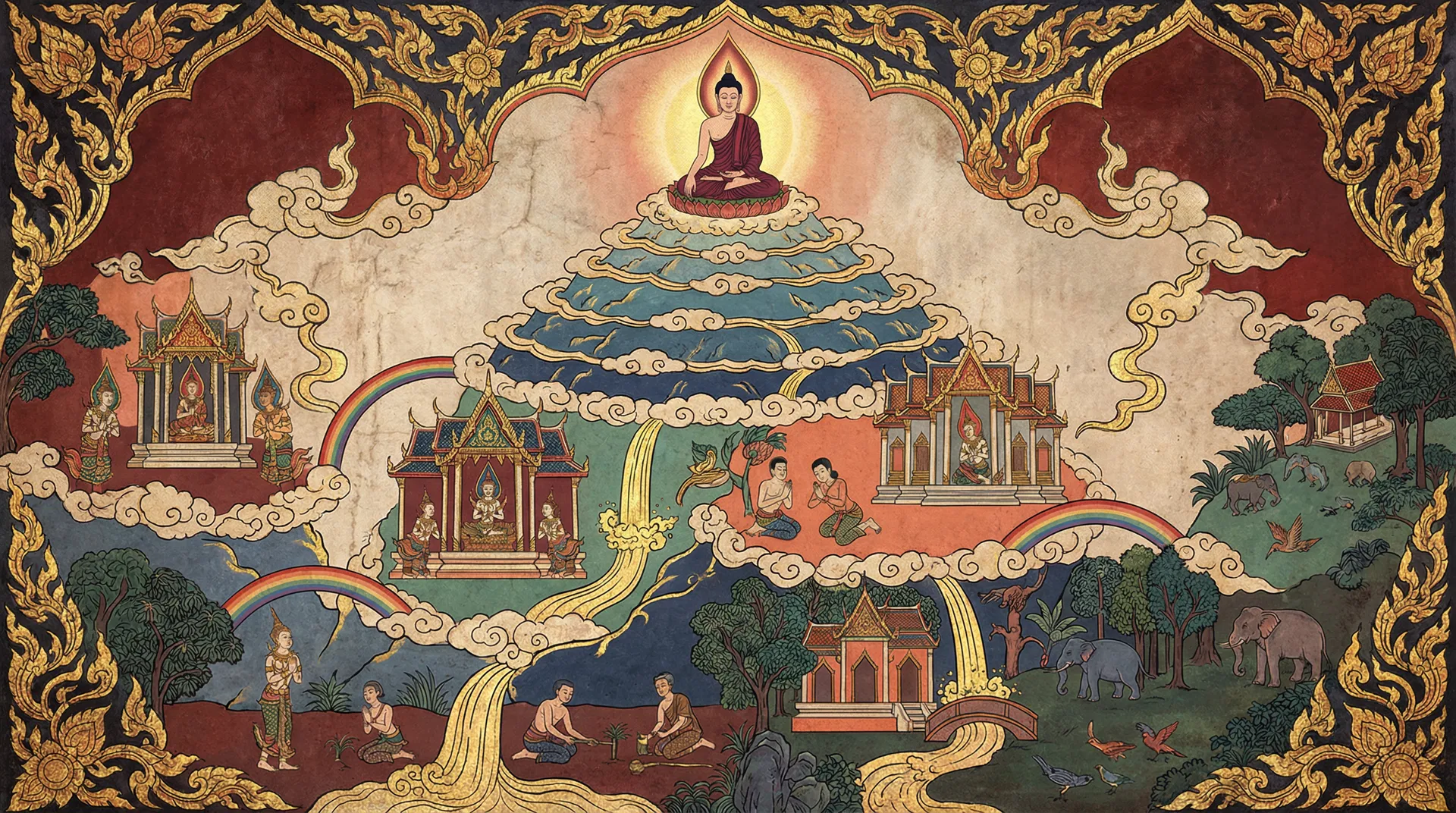
Kaccāni Jātaka
The Tale of the Wise Minister and the Foolish Brāhman
In the prosperous kingdom of Mithila, King Vedeha ruled with a gentle hand. His court was filled with wise counselors, but the most esteemed among them was a minister named Kaccāna, whose wisdom was as deep as the ocean and as sharp as a diamond. Kaccāna’s counsel was sought not only by the King but by all who faced dilemmas, for his understanding of human nature and his ability to discern truth from deception were unparalleled.
One day, a brāhman, a man of learning but lacking in practical wisdom, approached the King’s court. He was arrogant and self-important, believing his mastery of scriptures alone made him superior to all. He carried a small, tightly woven basket, adorned with flowers, and declared loudly, “Your Majesty, I have brought a treasure, a vessel of purest gold, capable of holding all the wealth in the universe! I shall offer it to the kingdom, but only if the King can prove his worthiness to receive such a gift.”
The King, intrigued, turned to his minister. “Kaccāna, what say you? A golden vessel that can hold all the wealth in the universe?”
Kaccāna, with a calm smile, observed the brāhman and his peculiar basket. “Your Majesty,” he said, “this brāhman speaks with great confidence. Let us test his claim.”
The brāhman puffed up with pride. “Ask me anything, King! My vessel is unmatched!”
Kaccāna stepped forward. “Brāhman,” he inquired, his voice measured, “you claim this basket can hold all the wealth of the universe. Tell me, what is the first thing you would place within it to prove its capacity?”
The brāhman, caught off guard, stammered, “I… I would first place seeds. For from seeds, all wealth grows.”
Kaccāna nodded slowly. “A reasonable start. And after the seeds?”
“After the seeds,” the brāhman declared, regaining some composure, “I would pour in grain. For grain is the sustenance of all beings, and from sustenance, all prosperity arises.”
“And after the grain?” Kaccāna pressed gently.
“After the grain,” the brāhman continued, his voice growing more animated, “I would add precious metals – gold, silver, jewels! For these are the symbols of wealth and power!”
“And then?” Kaccāna’s gaze was steady.
The brāhman, now quite enthusiastic, declared, “Then, I would add all the lands, all the palaces, all the armies! For these are the foundations of kingdoms and empires!” He paused, triumphant. “And still, my basket will have room!”
Kaccāna looked at the small, unassuming basket and then back at the brāhman. “Brāhman, you speak of seeds, grain, metals, lands, and palaces. But have you considered that all these things, no matter how vast, are ultimately held within the confines of a single entity that precedes them all?”
The brāhman looked utterly bewildered. “What entity could that be, wise minister?”
Kaccāna smiled, a knowing glint in his eyes. “It is the human mind, brāhman. Before any seed can be sown, the mind must conceive of its potential. Before grain can be harvested, the mind must envision its necessity. Before gold can be minted, the mind must assign it value. Before lands can be conquered, the mind must harbor the ambition. All the wealth of the universe, all its possibilities, begin and end within the vast, boundless expanse of the human mind.
“Your basket,” Kaccāna continued, pointing to the woven container, “can hold seeds, grain, and even gold. But can it hold the ambition that desires them? Can it hold the fear of loss that plagues the wealthy? Can it hold the satisfaction of contentment, or the sting of envy? Can it hold the wisdom that understands true value, or the folly that chases fleeting riches? Your basket is woven of reeds, brāhman, but the human mind is woven of thoughts, desires, and consciousness. It is the true vessel, capable of containing infinite universes of thought and potential, or of being a prison of its own limitations.”
The brāhman stood silent, his arrogance deflating like a punctured balloon. He looked at his basket, then at the wise minister, and finally, at his own hands, as if seeing them for the first time. He understood that his claim was not merely untrue, but fundamentally misguided. True wealth was not in material possessions, but in the capacity of the mind to understand, to create, and to be content.
King Vedeha, impressed by Kaccāna’s profound insight, rewarded the minister handsomely. The brāhman, humbled and enlightened, abandoned his boastful ways and began to study the workings of his own mind, seeking true wisdom rather than superficial acclaim. The tale of the basket became a timeless lesson in Mithila, reminding all that the greatest treasures lie not in outward acquisition, but in the inner cultivation of the mind.
The human mind is the ultimate vessel, capable of containing infinite possibilities. True wealth lies not in material possessions, but in the wisdom, understanding, and contentment cultivated within oneself.
— In-Article Ad —
💡Moral of the Story
The human mind is the source of all potential and value; cultivating inner wisdom and contentment is the truest form of wealth.
Perfection: Wisdom (Paññā)
— Ad Space (728x90) —
More Jataka Tales You May Enjoy
 425Aṭṭhakanipāta
Nimi Jātaka
Nimi JātakaIn the prosperous kingdom of Mithila, there once ruled a virtuous king named Nimi. King N...
💡 True happiness and lasting peace are found not in temporary pleasures, however grand, but in the unwavering pursuit of wisdom and liberation from the cycle of suffering. Understanding impermanence is key to making wise choices.
 36Ekanipāta
The Tale of the Horse-Breeder
In a past aeon, in the flourishing city of Varanasi, the Bodhisatta was born as a young Brahmin, end...
💡 The highest form of virtue is selfless compassion, willing to sacrifice for the well-being of others.
6EkanipātaThe Compassionate Elephant
The Compassionate ElephantIn the heart of a vast, sun-drenched savanna, where acacia trees dotted th...
💡 True compassion demands the greatest sacrifice, and love can transform the world.
31EkanipātaThe Bodhisatta as a King of Elephants
The Bodhisatta as a King of ElephantsIn the heart of a vast and verdant forest, where ancient trees ...
💡 Wise leadership, determination, and the ability to inspire trust can guide a community through perilous journeys to safety.
110EkanipātaMora Jataka
The Tale of the King, the Queen, and the Golden Peacock In the prosperous kingdom of Varanasi, nestl...
💡 True beauty lies not in outward appearance but in inner virtues like wisdom, compassion, and kindness. Superficial fascination can blind us to the enduring value of character.
 171Dukanipāta
Mahīsosaka Jātaka
Mahīsosaka JātakaIn the ancient kingdom of Mithila, nestled amongst rolling hills and verdant forest...
💡 True loyalty and affection cannot be bought or coerced. The worth of a creature, or a person, is not determined by external forces but by their inner spirit and their bonds with those who truly care for them.
— Multiplex Ad —